Tuesday, 28 April 2015

Smooth the Patchy Hedgehog


Do you know what is common between the 2 pictures shown above? They are both called ‘Sonic Hedgehog’! That’s true – in biochemistry, there is a signaling pathway known as the ‘Hedgehog Pathway’, and the proteins involved have funny names like ‘Sonic hedgehog’, ‘Smoothened’ and ‘Patched’. The April issue of Nature Chemical Biology has a really great perspective article on this pathway and the drug development involving this cell signaling circuit. [1] Indeed, Smoothened is an oncoprotein , which is coded by an oncogene. Oncogenes are obviously important because they are the ones which are overexpressed in pathological situations and ultimately lead to many type of cancer. The Hedgehog pathway is an very important signaling pathway, as it is actively involved in development. Of course, it is not at all an issue when you are developing, e.g. a fetus, but it is a big problem when you are mature. If these genes are overexpressed, it is a sort of ‘over-reaction’ and the ultimate result is malignancy. It has been shown that the abnormal signaling of Hedgehog pathway can lead to basal cell carcinoma and also some childhood tumors. This article has a bit of molecular biology and chemistry, and should be really useful for biochemistry and molecular biology students.

A diagram explaining the Hedgehog Signalling Pathway. Taken from [2].

I would also like to provide a brief discussion about the Hedgehog pathway here.  At the start, the protein ‘Patched’ inhibit the activity of ‘Smoothened’, which is a 7-transmembrane spanning, GPCR like protein. After the Hedgehog protein is cleaved and covalently modified by the addition of a palmitoyl and a cholesterol group ( both are fatty groups), that becomes hydrophobic and so it can associate with the membrane and its diffusion ability  will be limited as a result. This is indeed important because it has be previously shown that a reasonable amount of Hedgehog protein has to be present to effect downstream signaling, and so the limited diffusion  will help to establish a concentration of the Hedgehog protein.  Now, before we understand what the Hedgehog protein is up to, let us divert ourselves for one further detail. In the cell there exists a Hedgehog signaling complex (HSC), which is a series of protein that is associated with the microtubule in the cell. Among those proteins is a transcription factor called Ci, and when Ci is cleaved, it moves into the nucleus and lead to a reduced transcription of relevant genes.  However, when Hedgehog protein is present, it binds to Patched, which no longer inhibits the Smoothened Protein. To state it another way, the Hedgehog protein ‘releases’ the Smoothened protein indirectly. Smoothened is then phosphorylated by Protein Kinase A and Casein Kinase 1. Phosphorylations also occur for the other proteins in HSC and they associate with the  phosphorylated Smoothened.  Eventually, the HSC complex is no longer associated with the microtubule, and Ci is not cleaved. Therefore,  the intact Ci cannot repress transcription as a result. That is why Smoothened is an oncoprotein – because it leads to an intact Ci, which is not able to put a brake on the transcription. The wheel goes on and then ‘abnormal’ proteins are over-produced as a result. Given that ‘Smoothened’ and ‘Patched’ are nemesis, it won’t be too wrong to say ‘Smooth the Patchy Hedgehog’!

If you are interested, you can explore more about this in any biochemistry textbooks - a reasonably great understanding has been developed about this fascinating pathway.

by Ed Law
28/4/2015

Reference:

1. Regulation of the oncoprotein Smoothened by small molecules
Hayley J Sharpe, Weiru Wang, Rami N Hannoush & Frederic J de Sauvage
Nature Chemical Biology, 2015, 11, 246-255. 
doi:10.1038/nchembio.1776

2. http://www.novusbio.com/hedgehogpathway.html


Friday, 27 March 2015

The Good, The Bad And The Ugly

The Organic, the Aqueous, and the Fluorous phasesin their Mexican Stand-Off. Taken from [1].


‘Every gun makes its own tune.’ 

– The Man with No Name (Clint Eastwood), in ‘The Good, The Bad And The Ugly’.
 
Chemistry, like life, is dictated by the golden rule 'like dissolves like'. Just like a Western film - the showdown is always between a good guy and a bad guy, right? But then there is the great Sergio Leone, who shows that human nature is not that simple (and Eastwood makes his day in this way). There can be 'The Good, The Bad, and The Ugly', and in chemistry there can be someone else who doesn't want to mend any fences with neither the greasy organic nor the watery aqueous. That, has something to do with a guy called 'Fluorine'.

A CH4 Molecule. Taken from [2].

A CF4 molecule. Taken from [3].

Fluorine is always special. It ranks the first in electronegativity (a really electron density bully here), and its size is huge. 4 small hydrogen atoms surround a big carbon atom to form methane (CH4), but when the hydrogen is swapped as fluorine, the resulting CF4 becomes 4 huge fluorine atoms burying 1 skinny
poor carbon atom. If you imagine you have a long carbon chains with all fluorines substituted on it - the result can be said as a 'fluorine blanket'.

That leads us to a new concept known as 'Fluorous'. 'Fluorous', to start with, is related to fluorine.  Yet to understand how we can get something from this, we have to be careful about the meaning. A compound with fluorine atoms on it does not necessarily mean it is 'fluorous', as 'fluorous' takes a rather narrow definition. First, you have to have a lot of fluorine atoms in a compound to be fluorous (the current understanding is that the fluorine content should contribute to at least 60% of the total molecular weight1), and second, the fluorine atoms have to be closely packed on the organic molecule, not dispersed throughout a fatty organic compound with a large molecular weight. If these 2 criteria can be fulfilled, when you dissolve a fluorous compound or solvent into an organic phase, even though it is non-polar (means it hates water), it can still be separated into 2 phases, and so a fluorous-organic bi-phase can be established. This is great because you can start to engineer novel concepts in reaction design and catalysis, and this should simplify separation and purification procedures.

This time, I will share with you 2 pieces of great work that is related to fluorous chemistry.

by Ed Law
27/03/2015


Reference:

1. http://www.fluorous.com/journal/?paged=65
2. http://commons.wikimedia.org/wiki/File:Methane-3D-space-filling.png
3. http://commons.wikimedia.org/wiki/File:Tetrafluoromethane-3D-vdW.png
4. I. T. Horváth, J. Rábai , Science, 1994, 266, 5182, 72-75. 
5. For those organic compounds which have a fluorine content of more than 60%, they are specifically known as ‘heavy’ fluorous compound. There are also ‘light’ fluorous compounds (which has <40% Fluorine by weight, see Handbook of Fluorous Chemistry, Chapter 8 and references cited therein). In my following 2 articles, the term ‘fluorous’ means ‘heavy’ fluorous compounds.


Shake Hands In The Fluorous Phase

Match (left) and Mismatch (right). When a (S)-Fluorous BINOL interacts with a (R)-amino alcohol (left), it results in strong fluorescence. This is not the case for the interaction between a (S)-Fluorous BINOL and a (S)-amino alcohol (right), in which only a little fluorescence can be detected. Taken from [1].


The first paper regards the development of a chemical sensor molecule that can sense enantiomeric phenomenons in a fluorous phase. The compound is a chiral perfluoroalkyl-BINOL based diketone, and the researchers have shown that this new compound can serve as an enantioselective fluorescent sensor when it is dissolved into a fluorous phase. That kind of suggests that, when an enantiomer of this compound encounters a substrate with a particular enantiomeric configuration, they will interact and result in a large enhancement in fluorescent signals. The researchers have hypothesized, and also have confirmed that the rationale of this is due to formation of large-sized aggregates which can then be observed by dynamic light-scattering techniques.

The first generation (S)-BINOL. This candidate is not 'fluorous' enough to serve as a fluorous sensor. Modified from [1].


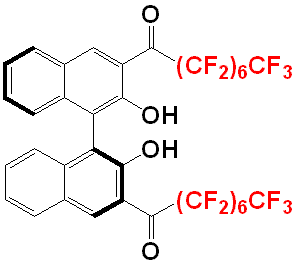
Now the big question, how can they make a greasy BINOL to partition into a fluorous phase? Their first generation compound will not work, and that illustrates the point of the 2 criteria I have mentioned above. True, it does contain 2 attention-attracting CF3 groups (which medicinal chemists love because they often positively impact the activity of a drug molecule), but the compound is simply not fluorous enough. The fluorine content is way lower than 60%, and they are far away from each other. So, as they have confirmed, this compound simply dissolves in the organic solvent and does not crash out as a second phase. So how can they solve the problem? You get it – increase the fluorine content of the BINOL compound. So, the second generation BINOL they use in this work, consists of 2 C7F15 groups (a total of 2 sets of 15 closely-packed fluorine atoms here!) and this is more than enough for the compound to partition into a fluorous phase. 


The novel fluorous (S)-BINOL. This compound is fluorous enough to preferentially partitioned into the fluorous phase in a bi-phasic system. Modified from [1]. 


To explain the reaction they study, I will use a notation and a diagram here. The reaction involves the BINOL and also an amino alcohol, and both of these compounds are enantiomeric. The 2 enantiomers of the BINOL are denoted as ‘A’ and ‘a’ (R and S configuration respectively), and the 2 enantiomers of the amino alcohol are denoted as ‘B’ and ‘b’ (ditto).


The 'Match' cases that will lead to intense fluorescence signals. Modified from [1].


What they have discovered is that the R enantiomer of the BINOL can interact only with the S enantiomer of the amino alcohol to give a significant increase in fluorescence signal, and vice versa. That means ‘A’ interacts with ‘b’, and ‘B’ interacts with ‘a’. They have also analyzed the reaction mixture and are able to propose that a nucleophilic addition has occurred between the BINOL and the amino alcohol to form an oxazolidine structure. If A interacts with B (or a interacts with b), the fluorescence intensity is much smaller – which means a ‘mismatch’ in pair takes place. So, this is seen as a sort of chiral recognition. The scope of the amino alcohol can be expanded and even diamines have been tried.

This is certainty a great reaction done in the fluorous phase, as it involves a highly perfluorinated BINOL compound. Coupled with fluorescence techniques, that makes the chiral recognition technique easily observable and quantifiable at the same time.

by Ed Law
27/03/2015 


Reference:

1. Enantioselective Fluorescent Recognition in the Fluorous Phase: Enhanced Reactivity and Expanded Chiral Recognition. C. Wang, E. Wu,  X. Wu, X. Xu, G. Zhang, L. Pu.
DOI: 10.1021/ja512569m


Fluoro-Soap

Structure of a micelle. Taken from http://en.wikipedia.org/wiki/File:Micelle.png
This great paper is on the Chemistry-Biology interface. The group has developed a novel fluorinated (rightfully a ‘fluorous’) detergent that can find potential applications in membrane biology. Membrane proteins are biologically important, they serve as many drug targets, and infamously difficult to deal with. Detergents are often used to solubilize the membrane proteins so that they could be manipulated for further studies. Detergents are amphiphiles, which means they have both a polar and a non-polar part, so that they can interact with the phospholipid and thereby disrupt the membrane bilayer structure.


As I have said, a fluorous compound does not necessarily like the 'fatty' organic layer, so a 2-phase system can be generated potentially. However, traditional wisdom suggests that although fluorinated compounds don't like aqueous phase too, that does not make them good detergents. The reason is two fold - first, the fact that fluorous and organic are not miscible means that it can be hard for fluorous compounds to interact with the organic membranes. And fluorine atoms are large compared to hydrogen atoms, so sterically it can be tough for them to mingle with the membranes. So, fluorous compounds are considered detergent-resistant, and they are less likely as candidates of great detergents. That is not the end of the world - because if there exists a ‘fluorinated detergent’, then its fluorinated tail will be unlikely to interact with the hydrocarbon part of the membrane, and then the protein-membrane properties will not be affected and the integrity of the membrane protein will be restored. This paper just shows one of these cases.


The structure of F6OM, the detergent the researchers developed, and F6OPC, another detergent to compare with. Taken from [1].

The researchers have synthesized a novel fluorinated detergent known as F6OM, which consists of a carbohydrate end and a fluorous end (C6F13). They have compared F6OM with another fluorinated detergent known as F6OPC, to show how different their properties can be. While F6OPC also consists of a C6F13 terminal, it also consists of a polar, and indeed zwitterionic, end - a cationic ammonium and an anionic phosphate here. The respective self-assemblies of the 2 contenders are very different - F6OM appears as long rods but F6OPC looks like small spheres. 

By using light scattering experiment, the group discovers that micellar F6OM can solubilize with  a derivative of phosphocholine (POPC), and this solubilization can be enhanced by increasing the F6OM to a certain concentration, or increasing the temperature. This is  not the case for the counterpart F6OPC. The observations agree to conventional understanding – a higher temperature should encourage membrane destabilization and a faster detergent translocation. The researchers carry out further isothermal titration calorimetry (ITC) to develop a quantitative understanding of the phenomenon. Furthermore, they can establish a phase equilibrium of F6OM, as present in a bilayer or a micelle. At a medium concentration, both types are seen to co-exist. One thing I would like to point you to is the use of  31P and 19F NMR in this work. The dynamic upfield shift of CF3 signal in 19F NMR signifies solubilization.   


The SDS-Page analysis for refolding experiment. When the concentration of F6OM reaches a certain level, folded protein can be observed. This is not so in the case for F6OPC, even when its concentration is raised to the same level as F6OM. Taken from [1].
An interesting aspect of membrane biology is the study of unfolding / refolding of proteins and membranes, in a sense you are building (or reconstituting) the membrane architecture from scratch. Our F6OM turns out to be a great candidate as a chaperone for this. By adding a CH2 spacer between the fluorous group and the carbohydrate section, the analogue shows promise. First, this analogue has a self-assembly to make it appear like a membrane bilayer, and then a phospholipase (OmpLA) can be refolded, and the whole protein-membrane complex becomes a functional proteolipase. The SDS-Page analysis shows that when the concentration of  F6OM reaches a certain level, the phospholipase can be refolded into an active state, and this seems to out-rival the other contender, F6OPC.

I think this is a great paper that illustrates the use of a chemical compound for biological applications. There are a lot of nice techniques inside – electron microscopy, light scattering, ITC, Fluorescence Spectroscopy, NMR and various assays. I am aware of some of them but I do not have practical experiences on these for my work, so I have learnt a lot from this paper. I encourage you to read more about those techniques, especially if you are working in biochemistry / chemical biology!

by Ed Law
27/03/2015

Reference:

1. A Fluorinated Detergent for Membrane-Protein Applications E. Frotscher, B. Danielczak, C. Vargas, A. Meister, G. Durand, S. Keller.
DOI: 10.1002/anie.201412359


Friday, 13 February 2015

xe-NON-philia


The tetrahedral cage with Xenon inside it. Taken from (1).


The paper I want to share with you this time concerns a topic I am always fascinated with – Supramolecular Chemistry. We all know that organic chemistry is governed by covalent bonds, which in a sense hold the atoms together to give stable and interesting compounds. At the frontier of supramolecular chemistry, the forces are inter-molecular in nature. They are transient forces powerful enough to hold different molecules together. This has led to a lot of monumental achievements in the fields of nanotechnology, molecular recognition, sensor chemistry and so on.


A key concept in Supramolecular Chemistry is ‘sub-component assembly’. Imagine this concept as some sort of a molecular Lego Game. You have different chemical building blocks (termed the sub-components) and they form transient interactions which in turn hold them together to give a final structure. The final chemical structure is usually governed by thermodynamic factors, which means the pathway towards the final product is usually the one that gives the lowest energy state. It is possible to control the final result at will - for example, the inclusion of metal ions will lead to some metal-ligand interactions that can ‘narrow down’ the possible chemical pathways to the ones that are desirable. In this paper from Journal of American Chemical Society (JACS), this is indeed one of those cases. (1)


Telkki et. Al. has reported the synthesis of a chemical ‘cage’ – which means that certain chemical compounds can act as guests and reside inside this chemical structure. The shape of this cage is tetrahedral. Each of the 6 sides of the tetrahedron is made up from 2 simple chemical building blocks. Since there are heteroatoms (nitrogen in this case) on these 4 sides, they all have the potential to bond to a metal ion. And, the 4 vertices of the tetrahedron are Fe (II) ion. Thus the compound is self-assembled in an aqueous media (as the building blocks for the sides contain water-solubilizing groups) and this observation implies that the chemical properties of the ligands and the metal ions dictate the final course of the product formation.

Exotic aside, how can we use this chemical cage? The researchers have found that they can indeed encapsulate Xenon, a noble gas element. Since Xenon has a NMR-active isotope, therefore they can observe the difference in the chemical shifts when Xenon has been introduced into their system. Not only this can find use in NMR, the chemical cage can be used to ‘tame’ Xenon and allow the element to exhibit more controllable behavior, and this should contribute to chemical sensor technology. 


The novel cage from Sanders / Nitschke et. Al. Taken from (2).

Professors Sanders and Nitschke from Cambridge have also contributed tremendously to this field. They have a recent paper in Angew. Chem. , where they have made an interesting metallosupramolecular complex involving fullerene. (2) Check that out too if you are interested!

By Ed Law
13/2/2015


If you would like to explore more about the concept of molecular encapsulation, see:

Reference:

1. Encapsulation of Xenon by a Self-Assembled Fe4L6 Metallosupramolecular Cage.
J. Roukala, J. Zhu, C. Giri, K. Rissanen, P. Lantto, V.-V. Telkki, J. Am. Chem. Soc., Article ASAP. DOI: 10.1021/ja5130176, Publication Date (Web): February 5, 2015.

2. Guest-Induced Transformation of a Porphyrin-Edged FeII4L6 Capsule into a CuIFeII2L4 Fullerene Receptor.
D. M. Wood, W. Meng, T. K. Ronson, A. R. Stefankiewicz, J. K. M. Sanders and J. R. Nitschke, published online: 5 Feb 2015, DOI: 10.1002/anie.201411985.


Wednesday, 11 February 2015

Some Invaders (9/2/2015)

(Picture taken from http://www.cnb.csic.es/~meetinginvadosome/scientific-progamme.html.)


The concept of invadosomes in Molecular Cell Biology.


I am quite excited to hear about the concept of 'invadosome' in cell biology today. It is a set of spectacular cellular apparatus which acts as cell contacts when either some types of normal cells or tumor cells want to invade other cells, that is why it is important. The key component of the invadosome is related to its cytoskeletal machineries (in this case the F-Actin). When cellular signals, normal or nefarious, stimulate the corresponding cells, the assembly of F-actin takes place and the action is enhanced by a whole series of cytoskeletal proteins. Since focal adhesion is highly important for holding the cells together, it is not surprising at all to learn that focal adhesion kinase (FAK) will enhance the cytoskeletal action here. The completion of F-actin assembly will mobilize a whole series of extracellular matrix (ECM) - degradation machineries (such as metalloproteinases) - which will then chew up the web-like structure of the extracellular matrix. 

A personal observation from this insightful poster is that - the invadopodia (i.e. the bad guy which is related to cancer) is more 'sinister' than you bet. From the morphological diagrams, you can see that the structure of the invadopodia is far more angular and tight-knitted than the 'good guy' known as podosome. This appears to me that the invadopodia is 'ready to shoot', as an angular stance will provide a better focal adhesion strategy. This is indeed supported by the observations that these invadopodias are larger in size, they have longer persistence and have superior caliber in degrading ECM. Another fascinating question is - is there a dynamic equilibrium between the 2 types, i.e. can they interconvert? If the answer is yes, we will have to find out the conditions as this will be an important issue! A fascinating concept!

by Ed Law
9/2/2015

For the poster, please see:

Reference:

1. http://jcs.biologists.org/content/122/17/3009/F1.poster.jpg
2. http://www.cnb.csic.es/~meetinginvadosome/scientific-progamme.html


Historical Records

The first articles of my Science Blog from 2009 to 2011:

http://www.emockscience.blogspot.hk

It has been 4 years since I have written about science topics I am passionate about. Now one thing for sure - I'm back!

For those who are interested in cinema and creative writing, this is my other face:

http://www.emockedlaw.blogspot.hk

Enjoy!

Ed
11/2/2015