Monday, 15 June 2015

Forget-Me-Not, Iron Man

Figure 1. Taken from [1].

One aspect of organic chemistry that has always fascinated me is the possibility of ‘chemical memory’. In an organic molecule, the information is designated in the structure of the molecule itself – what formula (i.e. what atoms in it), how the atoms are arranged and most importantly, its stereochemistry (i.e. its 3D-arrangement). For the stereochemical information, chirality is the more important aspect, as it is the signature that distinguishes two molecules which has exactly the same atom arrangement and same formula.


It is well known that some chemical reactions can destroy the stereochemical information of the starting material. Take the classic example, a first-order, nucleophilic reaction – a SN1 reaction (Figure 2). The mechanism dictates that the leaving group first departs to generate a planar, positive-charged carbocation. The essential detail here is that it is planar. Because of this particular shape, an incoming nucelophile will have a 50% / 50% chance of either attacking from the top of the carbocation, or from the bottom. That means, judging from the stereochemistry from the product (‘R’ or ‘S’ form), that is absolutely no way you will know which starting isomer makes the product, because the sterochemical information is lost upon the formation of the planar carbocation.

 Figure 2. For the SN1 type reaction, the stereochemical information is lost upon the formation of the relatively stable tertiary / secondary carbocation, leading to a racemization of product. Taken from Clayden et. al., Organic Chemistry P.421.

In contrast, this is not the case for a SN2 reaction, which always results in an inversion of stereochemistry (if there is no neighbouring group participations), which means, for example, if you have a product as a ‘S’-isomer, you know it originates from a starting reactant in ‘R’-form, and vice versa (Figure 2).

The loss of stereochemical information can be really tragic, especially in the field of asymmetric synthesis, as a racemization via a proposed strategy basically suggests that your method is heading towards a dead-end. There are, however, examples that stereochemical information can be preserved. One of them is the ferrocene-based carbocation, which is conformationally stable, and therefore when the carbocation is attacked by a nucelophile, it will lead to a retention of configuration – which means the molecule ‘remembers’ its past stereochemistry (Figure 3). This type of chemistry is good news – because by design, we can control the outcome of the reaction confidently now!

Figure 3. Taken from [1].

The Organic Letters article I share with you this time is related to molecular memory, and the reaction is the classic Friedel-Crafts reaction [1]. As you may have learnt in high school, the key step of a Friedel-Crafts alkylation is the generation of a stable carbocation, via the action of a Lewis Acid (AlCl3, FeBr3, to name a few). The researchers have demonstrated that, with the inclusion of a silicon functionality, a retention of configuration can be achieved for the product, that means the compound has shown ‘molecular memory’ and remembers its initial stereochemical configuration.


The model reaction of the substrates without a silicon group shows that, upon reaction, a racemic mixture results. So, the planar carbocation leads to same amount of both the isomers (Figure 4).  
Figure 4. Control experiment leads to racemization, as expected. Taken from [1].

Upon the use of the silyl group and an iron salt as Lewis acid, a retention results for the product. Note the alcohol group in the starting material and the indole ring in the product are both pointing into the plane (Figure 5).

Figure 5. Retention of configuration from silyl substrates. Taken from [1].

They have provided a mechanistic rationale. They believe that the ‘molecular memory’ originated from the β –silyl effect, which leads to the stabilization of the carbacationic intermediate. Thus, the iron salt activates the –OH group and generates the conformationally stable carbacation, then the indole attacks and leads to the final product, with a net retention of configuration (Figure 6).

 Figure 6. Mechanistic rationale of the Friedel-Crafts alkylation. Taken from [1].


With iron man, I can remember my past now!

 by Ed Law
15/6/2015

The βSilyl Effect on the Memory of Chirality in Friedel−Crafts Alkylation Using Chiral αAryl Alcohols
Toshiki Nokami,Yu Yamane, Shunsuke Oshitani, Jun-ka Kobayashi, Shin-ichiro Matsui, Takashi Nishihara, Hidemitsu Uno, Shuichi Hayase, and Toshiyuki Itoh

Org. Lett., 2015, asap
DOI: 10.1021/acs.orglett.5b01582

Friday, 12 June 2015

Triangle goes viral

Figure 1. Taken from [1].


Just a quick one here. This is a paper from Organic Letters, where the researchers have made some fluorinated analogues of an inhibitor against Hepatitis C virus. An interesting aspect is that the chemical structure contains a triangle – no, I mean cyclopropyl, the 3-membered carbon ring.

Recently, it becomes known that a major strategy against Hepatitis C virus was to target a protease (NS3/4A), which is involved in the replication of the virus. A known inhibitor of this enzyme is the compound 2 in Figure 1. Not only this peptidomimetic have a di-peptide backbone, it also consists of a cyclopropyl-amino acid functionality. That is why if we want to start making analogues resembling this compound, we have to start with the cyclopropyl core.

The researchers of this paper decided to go one step further - they want to test whether the inclusion of a fluorine atom, bonding directly to the carbon atom in the cyclopropyl core, would lead to any improvement of the inhibitor.

The reason why this paper caught my attention was because I was fascinated by the cyclopropyl type structure, an also its synthesis, nevertheless we will not miss any other details.


Figure 2. Synthesis of the fluorinated cyclopropyl amino ester building block. Taken from [1].

The first stage is to make the protected, fluorinated cyclopropyl amino ester 8 (Figure 2). Using ethyl dibromofluoroacetate, they carried out a cycloproponation with the aminoacrylate 7, with Zn/LiCl at low temperature, with dropwise addition. Indeed, LiCl can accelerate many organozinc and also organomagnesium (Grignard reaction), but one thing important about LiCl (which I can convince you because I have done some related experiments). LiCl is really hygroscopic, so you have to heat it up and dry it under vacuum before use. Except this precaution, LiCl really helps to promote the reaction, and literature abounds with its use.  The resulting cyclopropyl amino ester was stable to column chromatography, and they got that with a reasonably great yield. Their next key challenge was to install the exocyclic double bond, sort of conjugated to the cyclopropyl ring. That involved a series of steps, and the pen-ultimate step involved a Wittig reaction to put in the double bond. After an acidic hydrolysis, they get the amino ester hydrochloride salt 6. 

Figure 3. Completion of Synthesis. Taken from [1].

The reason why they made the compound 6 was because they wanted to develop a strategy to make a fluorinated version of Simeprevir, and compound 6 was actually one of the 4 building blocks they are going to put together at the end. Indeed, their synthesis indeed exposed some of the chemical properties of the building blocks, including compound 6, from the side-reactions they encountered throughout the optimization (Figure 3). For example, a relative higher temperature led to the ring-opening of the cyclopropyl, and indeed they can monitor this because of the distinct 19F NMR shifts of the fluorine atoms in the decomposition products and the cyclopropyl fluorine (Figure 4). They counteracted the problem by lowering the temperature to -15 Celsius. The other key reactions to join the fragments together included a Mitsunobu, a ring-closing metathesis and a mixed anhydride coupling reaction. So, they have devised a novel strategy towards fluorinated analogues and they have also submitted their compounds to some preliminary antiviral activities studies.

Figure 4. 19F NMR showed that the chemical shift of the cyclopropyl fluorine should be very different from that of its decomposition products, which originated from a ring-opened intermediate. Indeed, it would be interesting if this olefinic intermeidate could be trapped by a quenching experiment, or some in-situ NMR experiments could be carried out to study the evolution of this reaction. Taken from Ref. [1].


by Ed Law
12/6/2015

Reference:

1. Toward the Synthesis of Fluorinated Analogues of HCV NS3/4A Serine Protease Inhibitors Using Methyl α-Amino-β-fluoro-β-vinylcyclopropanecarboxylate as Key Intermediate

G. Milanole, F. Andriessen, G. Lemonnier, M. Sebban, G. Coadou, S. Couve-Bonnaire, J.-F. Bonfanti, P. Jubault, and X. Pannecoucke

Org. Lett., 2015, asap
DOI: 10.1021/acs.orglett.5b01216


Tuesday, 26 May 2015

Chemical Rio Bravo

Figure 1. Four Representations of one-and-the same molecule. In (1), the fluorines are shown in axial or equatorial manners. In (2), we can see the flattened cyclohexane with all the fluorines pointing out of the page. In (3), the green atoms represent the fluorine atoms. In (4), the blue atoms represent the fluorine atoms, and a 'fluorine shield' is evident. Adapted from Ref. [1].

Making an organic compound with all the correct stereochemistry is tough, and it is even more challenging if that conformer is the highest-energy one. If both aims can be realized, the feat deserves recognition. The paper I share with you this time is exactly one of these cases. No, it is not the most complicated molecule in this universe. It just contains 6 carbons, 6 hydrogens, and 6 fluorines. Yet the chemical compound, known as cis 1,2,3,4,5,6-hexafluorocyclohexane (Figure 1), is the highest energy conformer, and it is a truly fascinating organofluorine molecule.


Professor O’Hagan’s group has synthesized this molecule, and has carried out both practical and theoretical investigations on the interesting properties of this molecule. [1] This compound is extreme – as I said before, fluorine atoms are larger in size than carbon, so a number of them can essentially bury the carbon atoms they bond to. And because this conformer has all the fluorine atoms pointing ‘up’, so what we have here looks like a ‘fluorine shield’.  Of course, if you understand conformational analysis in organic chemistry, you certainly appreciate that the  6 fluorine atoms are placed in an ‘E-A-E-A-E-A’ (or A-E-A-E-A-E) positions, where A is axial and E is equatorial.  You should try to build a molecular model yourself, to convince yourself that it is indeed the case.

Figure 2. The synthetic sequence leading to hexafluorocyclohexane. Taken from [1].

I would like to analyze the synthetic  sequence towards this molecule (Figure 2). Though the chemistry is rather traditional, the reactions illustrate the important stereochemical implications of all these classic reactions, in particular the aim here is to get one single correct stereoisomer.  

At first sight, the aim called for a 6-step procedure, as we needed to put in 6 fluorine atoms, and that could go up to 12 steps if we had to activate the functional groups into better leaving groups! The researchers have chosen an easily-available starting material, myoinositol (2), and with a well-established 6-step procedure, they made the meso-symmetric intermediate (3), which consisted of 2 epoxides and an diol. This arrangement was important: because they showed 3 sets of 1,2-relationships, and indeed many known reactions were great at doing functionalizations at 1,2-positions (dihydroxylation, iodolactonizations, di-functionalizations with Pd complexes etc.), so hopefully this would shorten the procedure, and the researchers were on the right track. 

By first using Deoxofluor, they installed 2 fluorines, with inversion, at the 2 hydroxy positions to afford intermediate (4). It made sense an inversion would have taken place, because the electrophilic sulfur on Deoxofluor would first react with the hydroxy groups to activate that into a better leaving group, and that should do with retention of configuration, as it would not touch the carbon center at all. Only when the nucleophilic fluorine source attached the saturated carbon center would lead to an ultimate inversion of configuration.

Then, they used Et3N. HF to open up simultaneously both epoxides to put on 2 more fluorine atoms onto the 6-membered ring, giving structure 5. Both were also inversions – because the fluoride ion attacked from one side of the ring in a ‘SN2’ (or SNi, someone might call it) manner. 

But it really was the installation of the final 2 fluorine atoms that have proved to be tricky. Indeed, the group has expended considerable efforts to probe the optimal conditions for installation  these  2 fluorine atoms. From their screening experiments, they arrived at the conclusion that not every general fluorination regents could lead to a promising result, and the sluggishness of these reactions signified the challenge of this fluorination reaction. At the end, they had to put the fluorine atoms on, one after another. They first converted the corresponding hydroxyl into their triflate (-OTf) group, and then reacted that with Et3N.HF at elevated temperature to get the fluorine atoms incorporated, giving finally the target (1). Classic again -  the triflation did not touch the carbon center, therefore retention of configuration. Only when the nucleophilc fluoride attacked the triflate would lead to an inversion of stereochemistry as a result. The researchers have carried out 19F NMR to develop further understanding of the reaction, and it was there they discovered the key side reactions occurred, like olefin generation due to elimination at elevated temperature.

The group has carried out X-ray crystallographic, VT-NMR, and also modeling studies to understand more about their new compound’s properties. The most interesting aspect is that the compound looks like a 'fluorine shield', where all the fluorine atoms are pointing at the same direction when the cyclohexane skeleton is flattened. The result is a high dipole moment, where the fluorinated ring is strongly polarized in one direction. While the structure is pretty simple, its special properties should make it useful as components in supramolecular architectures, for example the provision of a stable fluorine surface.

The famous director Howard Hawks believed in the power of ‘3’. Well, with carbon, hydrogen and fluorine, that may be the wisdom here.

by Ed Law
26/5/2015

Reference:

1. All-cis 1,2,3,4,5,6-hexafluorocyclohexane is a facially polarized cyclohexane
Neil S. Keddie, Alexandra M. Z. Slawin, Tomas Lebl, Douglas Philp and David O’Hagan*
Nature Chemistry 2015
DOI: 10.1038/NCHEM.2232


Tuesday, 28 April 2015

Smooth the Patchy Hedgehog


Do you know what is common between the 2 pictures shown above? They are both called ‘Sonic Hedgehog’! That’s true – in biochemistry, there is a signaling pathway known as the ‘Hedgehog Pathway’, and the proteins involved have funny names like ‘Sonic hedgehog’, ‘Smoothened’ and ‘Patched’. The April issue of Nature Chemical Biology has a really great perspective article on this pathway and the drug development involving this cell signaling circuit. [1] Indeed, Smoothened is an oncoprotein , which is coded by an oncogene. Oncogenes are obviously important because they are the ones which are overexpressed in pathological situations and ultimately lead to many type of cancer. The Hedgehog pathway is an very important signaling pathway, as it is actively involved in development. Of course, it is not at all an issue when you are developing, e.g. a fetus, but it is a big problem when you are mature. If these genes are overexpressed, it is a sort of ‘over-reaction’ and the ultimate result is malignancy. It has been shown that the abnormal signaling of Hedgehog pathway can lead to basal cell carcinoma and also some childhood tumors. This article has a bit of molecular biology and chemistry, and should be really useful for biochemistry and molecular biology students.

A diagram explaining the Hedgehog Signalling Pathway. Taken from [2].

I would also like to provide a brief discussion about the Hedgehog pathway here.  At the start, the protein ‘Patched’ inhibit the activity of ‘Smoothened’, which is a 7-transmembrane spanning, GPCR like protein. After the Hedgehog protein is cleaved and covalently modified by the addition of a palmitoyl and a cholesterol group ( both are fatty groups), that becomes hydrophobic and so it can associate with the membrane and its diffusion ability  will be limited as a result. This is indeed important because it has be previously shown that a reasonable amount of Hedgehog protein has to be present to effect downstream signaling, and so the limited diffusion  will help to establish a concentration of the Hedgehog protein.  Now, before we understand what the Hedgehog protein is up to, let us divert ourselves for one further detail. In the cell there exists a Hedgehog signaling complex (HSC), which is a series of protein that is associated with the microtubule in the cell. Among those proteins is a transcription factor called Ci, and when Ci is cleaved, it moves into the nucleus and lead to a reduced transcription of relevant genes.  However, when Hedgehog protein is present, it binds to Patched, which no longer inhibits the Smoothened Protein. To state it another way, the Hedgehog protein ‘releases’ the Smoothened protein indirectly. Smoothened is then phosphorylated by Protein Kinase A and Casein Kinase 1. Phosphorylations also occur for the other proteins in HSC and they associate with the  phosphorylated Smoothened.  Eventually, the HSC complex is no longer associated with the microtubule, and Ci is not cleaved. Therefore,  the intact Ci cannot repress transcription as a result. That is why Smoothened is an oncoprotein – because it leads to an intact Ci, which is not able to put a brake on the transcription. The wheel goes on and then ‘abnormal’ proteins are over-produced as a result. Given that ‘Smoothened’ and ‘Patched’ are nemesis, it won’t be too wrong to say ‘Smooth the Patchy Hedgehog’!

If you are interested, you can explore more about this in any biochemistry textbooks - a reasonably great understanding has been developed about this fascinating pathway.

by Ed Law
28/4/2015

Reference:

1. Regulation of the oncoprotein Smoothened by small molecules
Hayley J Sharpe, Weiru Wang, Rami N Hannoush & Frederic J de Sauvage
Nature Chemical Biology, 2015, 11, 246-255. 
doi:10.1038/nchembio.1776

2. http://www.novusbio.com/hedgehogpathway.html


Friday, 27 March 2015

The Good, The Bad And The Ugly

The Organic, the Aqueous, and the Fluorous phasesin their Mexican Stand-Off. Taken from [1].


‘Every gun makes its own tune.’ 

– The Man with No Name (Clint Eastwood), in ‘The Good, The Bad And The Ugly’.
 
Chemistry, like life, is dictated by the golden rule 'like dissolves like'. Just like a Western film - the showdown is always between a good guy and a bad guy, right? But then there is the great Sergio Leone, who shows that human nature is not that simple (and Eastwood makes his day in this way). There can be 'The Good, The Bad, and The Ugly', and in chemistry there can be someone else who doesn't want to mend any fences with neither the greasy organic nor the watery aqueous. That, has something to do with a guy called 'Fluorine'.

A CH4 Molecule. Taken from [2].

A CF4 molecule. Taken from [3].

Fluorine is always special. It ranks the first in electronegativity (a really electron density bully here), and its size is huge. 4 small hydrogen atoms surround a big carbon atom to form methane (CH4), but when the hydrogen is swapped as fluorine, the resulting CF4 becomes 4 huge fluorine atoms burying 1 skinny
poor carbon atom. If you imagine you have a long carbon chains with all fluorines substituted on it - the result can be said as a 'fluorine blanket'.

That leads us to a new concept known as 'Fluorous'. 'Fluorous', to start with, is related to fluorine.  Yet to understand how we can get something from this, we have to be careful about the meaning. A compound with fluorine atoms on it does not necessarily mean it is 'fluorous', as 'fluorous' takes a rather narrow definition. First, you have to have a lot of fluorine atoms in a compound to be fluorous (the current understanding is that the fluorine content should contribute to at least 60% of the total molecular weight1), and second, the fluorine atoms have to be closely packed on the organic molecule, not dispersed throughout a fatty organic compound with a large molecular weight. If these 2 criteria can be fulfilled, when you dissolve a fluorous compound or solvent into an organic phase, even though it is non-polar (means it hates water), it can still be separated into 2 phases, and so a fluorous-organic bi-phase can be established. This is great because you can start to engineer novel concepts in reaction design and catalysis, and this should simplify separation and purification procedures.

This time, I will share with you 2 pieces of great work that is related to fluorous chemistry.

by Ed Law
27/03/2015


Reference:

1. http://www.fluorous.com/journal/?paged=65
2. http://commons.wikimedia.org/wiki/File:Methane-3D-space-filling.png
3. http://commons.wikimedia.org/wiki/File:Tetrafluoromethane-3D-vdW.png
4. I. T. Horváth, J. Rábai , Science, 1994, 266, 5182, 72-75. 
5. For those organic compounds which have a fluorine content of more than 60%, they are specifically known as ‘heavy’ fluorous compound. There are also ‘light’ fluorous compounds (which has <40% Fluorine by weight, see Handbook of Fluorous Chemistry, Chapter 8 and references cited therein). In my following 2 articles, the term ‘fluorous’ means ‘heavy’ fluorous compounds.


Shake Hands In The Fluorous Phase

Match (left) and Mismatch (right). When a (S)-Fluorous BINOL interacts with a (R)-amino alcohol (left), it results in strong fluorescence. This is not the case for the interaction between a (S)-Fluorous BINOL and a (S)-amino alcohol (right), in which only a little fluorescence can be detected. Taken from [1].


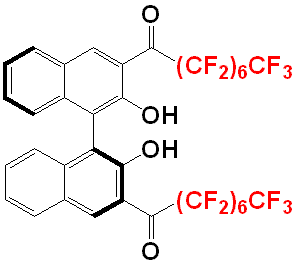
The first paper regards the development of a chemical sensor molecule that can sense enantiomeric phenomenons in a fluorous phase. The compound is a chiral perfluoroalkyl-BINOL based diketone, and the researchers have shown that this new compound can serve as an enantioselective fluorescent sensor when it is dissolved into a fluorous phase. That kind of suggests that, when an enantiomer of this compound encounters a substrate with a particular enantiomeric configuration, they will interact and result in a large enhancement in fluorescent signals. The researchers have hypothesized, and also have confirmed that the rationale of this is due to formation of large-sized aggregates which can then be observed by dynamic light-scattering techniques.

The first generation (S)-BINOL. This candidate is not 'fluorous' enough to serve as a fluorous sensor. Modified from [1].


Now the big question, how can they make a greasy BINOL to partition into a fluorous phase? Their first generation compound will not work, and that illustrates the point of the 2 criteria I have mentioned above. True, it does contain 2 attention-attracting CF3 groups (which medicinal chemists love because they often positively impact the activity of a drug molecule), but the compound is simply not fluorous enough. The fluorine content is way lower than 60%, and they are far away from each other. So, as they have confirmed, this compound simply dissolves in the organic solvent and does not crash out as a second phase. So how can they solve the problem? You get it – increase the fluorine content of the BINOL compound. So, the second generation BINOL they use in this work, consists of 2 C7F15 groups (a total of 2 sets of 15 closely-packed fluorine atoms here!) and this is more than enough for the compound to partition into a fluorous phase. 


The novel fluorous (S)-BINOL. This compound is fluorous enough to preferentially partitioned into the fluorous phase in a bi-phasic system. Modified from [1]. 


To explain the reaction they study, I will use a notation and a diagram here. The reaction involves the BINOL and also an amino alcohol, and both of these compounds are enantiomeric. The 2 enantiomers of the BINOL are denoted as ‘A’ and ‘a’ (R and S configuration respectively), and the 2 enantiomers of the amino alcohol are denoted as ‘B’ and ‘b’ (ditto).


The 'Match' cases that will lead to intense fluorescence signals. Modified from [1].


What they have discovered is that the R enantiomer of the BINOL can interact only with the S enantiomer of the amino alcohol to give a significant increase in fluorescence signal, and vice versa. That means ‘A’ interacts with ‘b’, and ‘B’ interacts with ‘a’. They have also analyzed the reaction mixture and are able to propose that a nucleophilic addition has occurred between the BINOL and the amino alcohol to form an oxazolidine structure. If A interacts with B (or a interacts with b), the fluorescence intensity is much smaller – which means a ‘mismatch’ in pair takes place. So, this is seen as a sort of chiral recognition. The scope of the amino alcohol can be expanded and even diamines have been tried.

This is certainty a great reaction done in the fluorous phase, as it involves a highly perfluorinated BINOL compound. Coupled with fluorescence techniques, that makes the chiral recognition technique easily observable and quantifiable at the same time.

by Ed Law
27/03/2015 


Reference:

1. Enantioselective Fluorescent Recognition in the Fluorous Phase: Enhanced Reactivity and Expanded Chiral Recognition. C. Wang, E. Wu,  X. Wu, X. Xu, G. Zhang, L. Pu.
DOI: 10.1021/ja512569m


Fluoro-Soap

Structure of a micelle. Taken from http://en.wikipedia.org/wiki/File:Micelle.png
This great paper is on the Chemistry-Biology interface. The group has developed a novel fluorinated (rightfully a ‘fluorous’) detergent that can find potential applications in membrane biology. Membrane proteins are biologically important, they serve as many drug targets, and infamously difficult to deal with. Detergents are often used to solubilize the membrane proteins so that they could be manipulated for further studies. Detergents are amphiphiles, which means they have both a polar and a non-polar part, so that they can interact with the phospholipid and thereby disrupt the membrane bilayer structure.


As I have said, a fluorous compound does not necessarily like the 'fatty' organic layer, so a 2-phase system can be generated potentially. However, traditional wisdom suggests that although fluorinated compounds don't like aqueous phase too, that does not make them good detergents. The reason is two fold - first, the fact that fluorous and organic are not miscible means that it can be hard for fluorous compounds to interact with the organic membranes. And fluorine atoms are large compared to hydrogen atoms, so sterically it can be tough for them to mingle with the membranes. So, fluorous compounds are considered detergent-resistant, and they are less likely as candidates of great detergents. That is not the end of the world - because if there exists a ‘fluorinated detergent’, then its fluorinated tail will be unlikely to interact with the hydrocarbon part of the membrane, and then the protein-membrane properties will not be affected and the integrity of the membrane protein will be restored. This paper just shows one of these cases.


The structure of F6OM, the detergent the researchers developed, and F6OPC, another detergent to compare with. Taken from [1].

The researchers have synthesized a novel fluorinated detergent known as F6OM, which consists of a carbohydrate end and a fluorous end (C6F13). They have compared F6OM with another fluorinated detergent known as F6OPC, to show how different their properties can be. While F6OPC also consists of a C6F13 terminal, it also consists of a polar, and indeed zwitterionic, end - a cationic ammonium and an anionic phosphate here. The respective self-assemblies of the 2 contenders are very different - F6OM appears as long rods but F6OPC looks like small spheres. 

By using light scattering experiment, the group discovers that micellar F6OM can solubilize with  a derivative of phosphocholine (POPC), and this solubilization can be enhanced by increasing the F6OM to a certain concentration, or increasing the temperature. This is  not the case for the counterpart F6OPC. The observations agree to conventional understanding – a higher temperature should encourage membrane destabilization and a faster detergent translocation. The researchers carry out further isothermal titration calorimetry (ITC) to develop a quantitative understanding of the phenomenon. Furthermore, they can establish a phase equilibrium of F6OM, as present in a bilayer or a micelle. At a medium concentration, both types are seen to co-exist. One thing I would like to point you to is the use of  31P and 19F NMR in this work. The dynamic upfield shift of CF3 signal in 19F NMR signifies solubilization.   


The SDS-Page analysis for refolding experiment. When the concentration of F6OM reaches a certain level, folded protein can be observed. This is not so in the case for F6OPC, even when its concentration is raised to the same level as F6OM. Taken from [1].
An interesting aspect of membrane biology is the study of unfolding / refolding of proteins and membranes, in a sense you are building (or reconstituting) the membrane architecture from scratch. Our F6OM turns out to be a great candidate as a chaperone for this. By adding a CH2 spacer between the fluorous group and the carbohydrate section, the analogue shows promise. First, this analogue has a self-assembly to make it appear like a membrane bilayer, and then a phospholipase (OmpLA) can be refolded, and the whole protein-membrane complex becomes a functional proteolipase. The SDS-Page analysis shows that when the concentration of  F6OM reaches a certain level, the phospholipase can be refolded into an active state, and this seems to out-rival the other contender, F6OPC.

I think this is a great paper that illustrates the use of a chemical compound for biological applications. There are a lot of nice techniques inside – electron microscopy, light scattering, ITC, Fluorescence Spectroscopy, NMR and various assays. I am aware of some of them but I do not have practical experiences on these for my work, so I have learnt a lot from this paper. I encourage you to read more about those techniques, especially if you are working in biochemistry / chemical biology!

by Ed Law
27/03/2015

Reference:

1. A Fluorinated Detergent for Membrane-Protein Applications E. Frotscher, B. Danielczak, C. Vargas, A. Meister, G. Durand, S. Keller.
DOI: 10.1002/anie.201412359